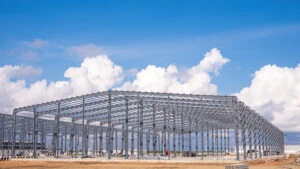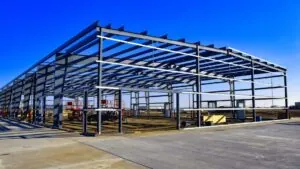
Choosing the right steel building supplier in Quebec shapes every downstream decision on your project, from engineering drawings stamped for the Code de construction du Quebec to delivery timelines across the province’s varied geography. A qualified supplier coordinates design, fabrication, and logistics as a single accountable partner, reducing the risk of specification gaps that cause costly delays. This guide explains what to look for, how supplier types differ, and what drives your final cost.
- Quebec’s bilingual regulatory environment and distinct building code requirements mean your supplier must be able to produce documentation in French and coordinate with local municipal permitting offices.
- Snow loads in Quebec range from moderate in the Montreal area to very heavy in regions such as the Laurentians, Saguenay, and Abitibi-Temiscamingue; your supplier’s engineering must reflect site-specific ground snow load (Ss) values from the National Building Code of Canada (NBC) climatic data.
- Pre-engineered metal buildings (PEMBs) and conventional structural steel are the two primary supply paths; each suits different project scales and timelines.
- Supplier vetting criteria include engineering capability, fabrication quality standards, delivery reach, and post-sale support.
- Cost drivers are dominated by steel tonnage, complexity, site access, and erection scope rather than any single line item.
Definitions & scope
A steel building supplier in the Quebec context is a company that designs, fabricates, and delivers the structural steel package for a building project. The term covers a spectrum from full-service pre-engineered metal building (PEMB) manufacturers that supply a complete kit of parts, to structural steel fabricators that produce custom frames for architect-designed buildings, to brokers who source components from third-party mills and fabricators.
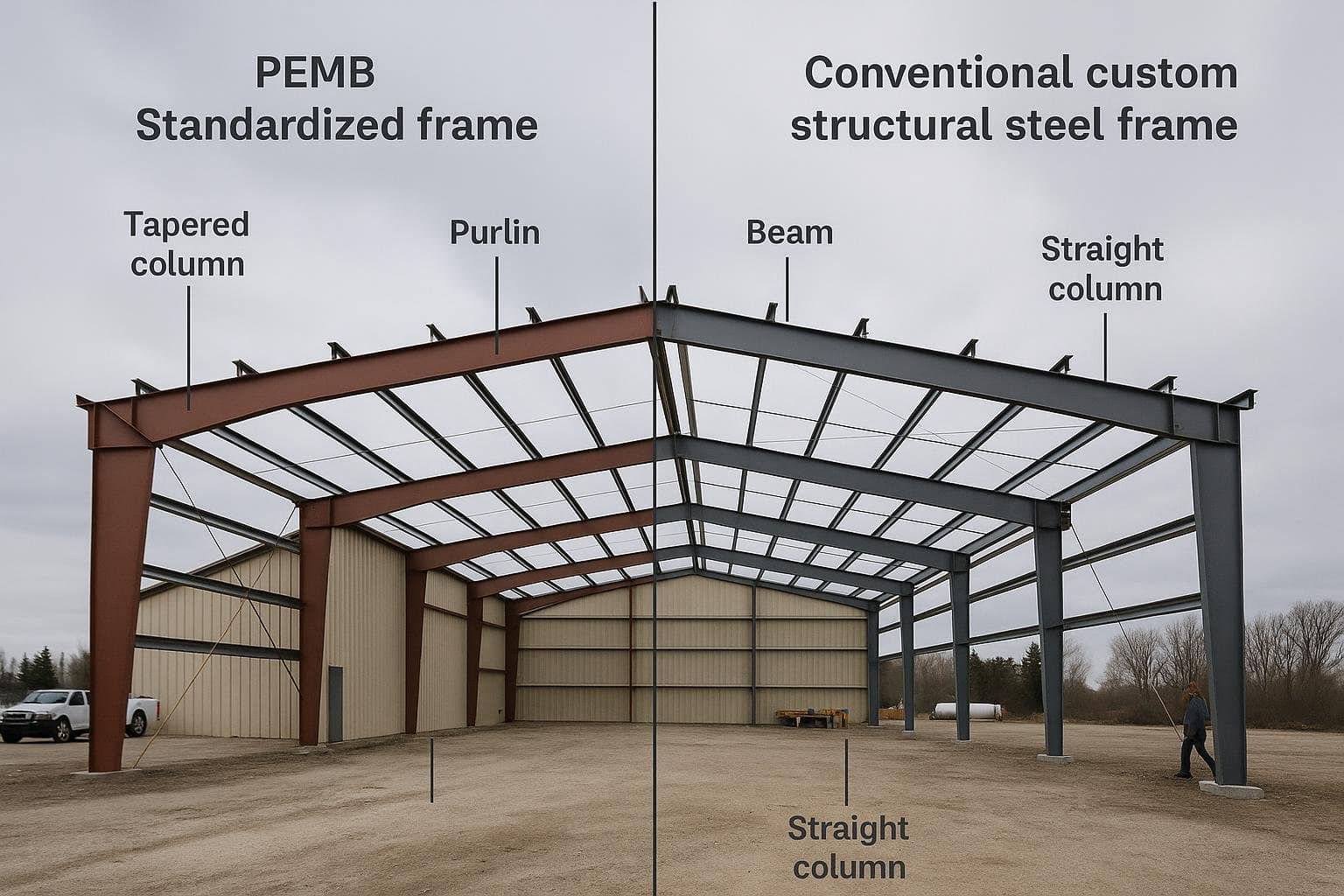
Pre-engineered buildings use standardized rigid-frame systems engineered to meet specific load combinations. The primary frame, secondary framing, cladding, and accessories are designed as an integrated system. Conventional or structural steel buildings are designed from first principles by a structural engineer and fabricated to those custom drawings. Hybrid approaches combine a PEMB primary frame with custom secondary elements.
Quebec’s construction industry is governed provincially by the Loi sur le batiment and the Code de construction du Quebec, which adopts the NBC with provincial amendments. Any supplier providing stamped engineering for Quebec projects must work with engineers licensed by the Ordre des ingenieurs du Quebec (OIQ). Understanding this distinction is essential when evaluating whether a supplier’s standard engineering package is valid for your municipality.
Why this matters
Quebec represents one of Canada’s largest construction markets, with significant demand across agricultural, industrial, commercial, and aviation sectors. The province’s climate presents engineering challenges that a supplier must address explicitly. Ground snow loads (Ss) published in the NBC Appendix C vary dramatically across Quebec: the Montreal metropolitan area carries lower design loads than the Laurentians, while regions such as Saguenay-Lac-Saint-Jean and the Lower North Shore carry among the highest loads in eastern Canada. A supplier who applies a generic national template without site-specific load verification creates structural and liability risk.
Quebec’s bilingual regulatory environment adds a layer of complexity. Municipal permit applications, inspection reports, and contractor communications often require French-language documentation. A supplier experienced in Quebec projects will have processes for producing bilingual or French-language engineering packages and will understand the workflow of local inspectors.
Seismic considerations also apply in certain Quebec regions. The Ottawa-St. Lawrence Lowlands and areas near the Charlevoix seismic zone carry non-trivial seismic hazard values that must be incorporated into the structural design. The historical Charlevoix seismic zone is a recognized reminder that Quebec is not seismically inert. Suppliers must confirm that their engineering accounts for the applicable seismic design category at your specific site.
Finally, Quebec’s geography affects logistics. Delivering a large steel package to a farm in Abitibi-Temiscamingue or a hangar near Sept-Iles involves different trucking constraints than a Montreal-area warehouse. A supplier’s delivery capability and experience with remote Quebec sites is a practical vetting criterion.
For a broader view of steel building supply across the country, see the Complete Guide to Steel Building Supply in Canada.

Your options
Pre-engineered metal building (PEMB) suppliers
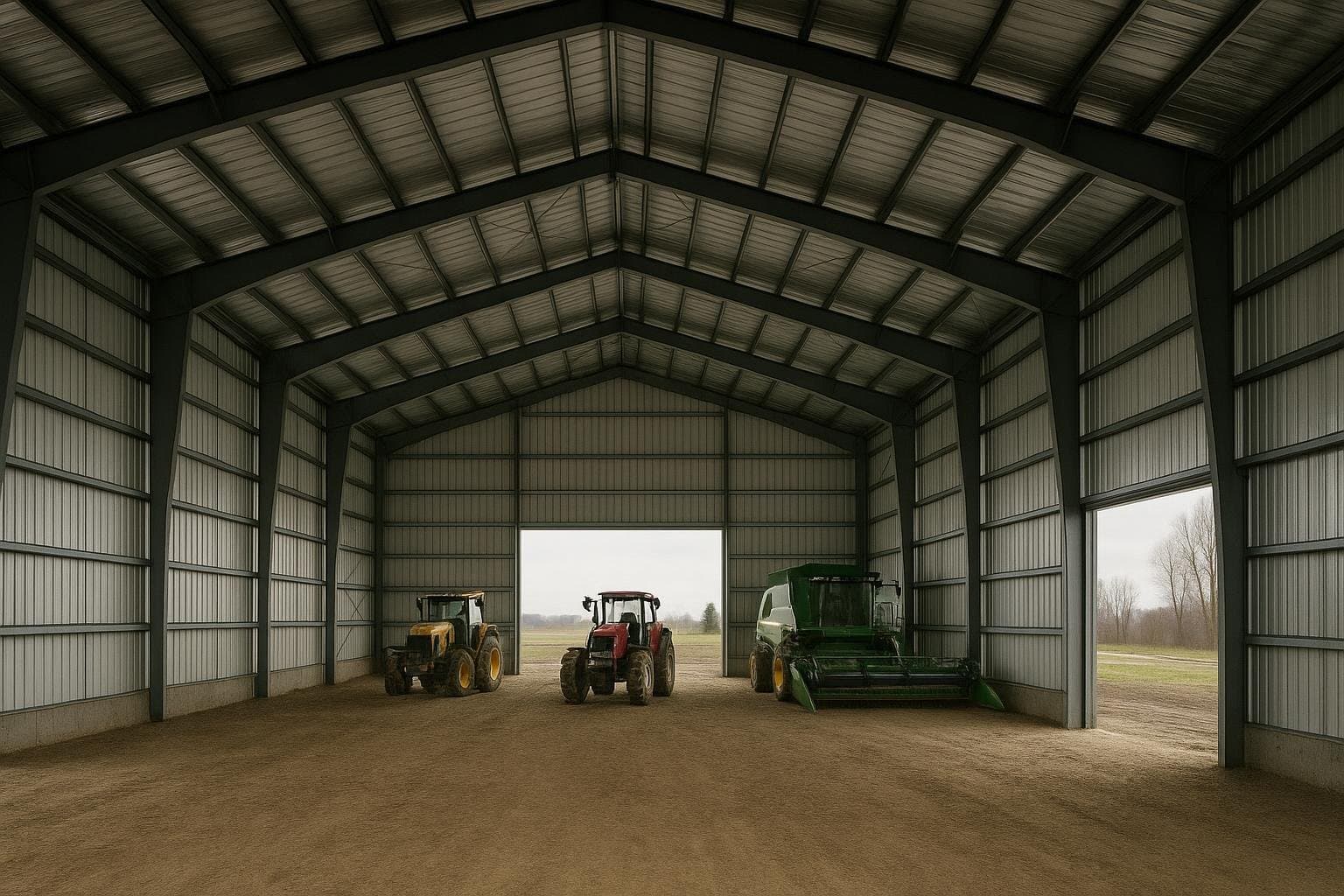
A PEMB supplier designs and fabricates a complete structural package: primary rigid frames, secondary framing (purlins, girts), roof and wall panels, trim, and accessories. The system is engineered as a unit, which allows efficient use of steel and faster fabrication lead times compared to fully custom structural steel. PEMBs are well suited to clear-span agricultural buildings, warehouses, garages, and light industrial facilities. The limitation is that highly irregular floor plans, very large column-free spans, or buildings with complex architectural requirements may push beyond what a standard PEMB catalogue accommodates efficiently.
Conventional structural steel fabricators
Conventional fabricators produce custom steel frames designed by a structural engineer to meet specific architectural and load requirements. This path is appropriate for large-span industrial buildings, multi-storey structures, complex geometries, or projects where an architect has already produced design drawings. Lead times are typically longer than PEMB because each component is custom-detailed. Cost per tonne of steel is generally higher, though the ability to optimize for a specific design can offset this on complex projects.
Full-service design-supply partners
Some suppliers act as a single point of contact from concept through delivery, coordinating structural engineering, architectural input, permit documentation, and fabrication. This model reduces the coordination burden on the owner and is particularly valuable in Quebec where bilingual documentation and OIQ-licensed engineering must be managed simultaneously. The limitation is that the owner has less direct control over individual subcontractors and must trust the partner’s quality management processes.
Kit suppliers and brokers
Kit suppliers sell packaged building systems, often sourced from a manufacturing partner, with varying levels of engineering support. Brokers source components from multiple fabricators and assemble a package. These options can be cost-competitive for simple, smaller projects but require the buyer to verify that engineering is site-specific and that the supplier has accountability for the complete package rather than individual components. In Quebec, confirming that stamped drawings are signed by an OIQ-licensed engineer is non-negotiable.
Agricultural building specialists
Some suppliers focus specifically on farm and agricultural structures: grain storage, livestock barns, equipment storage, and riding arenas. These suppliers understand agricultural use cases, ventilation requirements for livestock, and the practical needs of farm operations. Quebec’s agricultural sector, particularly in regions such as Monteregie, Centre-du-Quebec, and Chaudiere-Appalaches, generates consistent demand for this building type. See Titan’s Agricultural Steel Buildings in Quebec page for product-specific detail.
Aviation and hangar specialists
Aircraft hangars require large clear-span openings, specific door system engineering, and compliance with Transport Canada facility standards. Suppliers with hangar experience understand bi-fold, hydraulic, and sliding door systems, apron drainage requirements, and the coordination needed with airport authorities. Quebec has numerous regional airports and private airstrips where hangar demand exists. For more detail, see the guide on Steel Airplane Hangar Buildings in Canada.
Options compared
| Supplier type | Best for | Typical considerations | Limitations |
|---|---|---|---|
| PEMB supplier | Warehouses, agricultural buildings, garages, light industrial | Integrated engineering; faster fabrication; bilingual documentation varies by supplier | Less flexible for complex geometries or very large clear spans |
| Conventional fabricator | Large industrial, multi-storey, architect-designed projects | Custom-detailed to any design; OIQ engineer coordination required | Longer lead times; higher per-tonne cost on simpler projects |
| Full-service design-supply partner | Owners wanting single-point accountability; complex Quebec permit environments | Manages bilingual documentation, engineering, and fabrication | Less owner control over individual subcontractors |
| Kit supplier / broker | Smaller, simpler projects with budget constraints | Potentially lower cost; buyer must verify OIQ stamp and site-specific engineering | Accountability gaps between components; engineering quality varies |
| Agricultural specialist | Farm buildings, livestock barns, grain storage, riding arenas | Understands agricultural ventilation and use-case requirements | May not offer industrial or commercial building types |
| Aviation / hangar specialist | Aircraft hangars, airport facilities | Clear-span door systems, Transport Canada coordination | Specialized scope; not suited to general commercial or agricultural |
The table above illustrates that no single supplier type is universally superior. A Quebec grain farmer in Monteregie and a logistics operator building a large warehouse near Montreal have fundamentally different needs. The most important filter is whether the supplier can produce OIQ-stamped, site-specific engineering for your location and use case, and whether they have a documented process for Quebec’s bilingual permit environment.
How to choose
Use the following decision framework to narrow your supplier selection before requesting quotes.
Choose a PEMB supplier if your project is a clear-span agricultural building, warehouse, garage, or light industrial facility with a relatively standard footprint. PEMBs deliver faster lead times and integrated engineering, which suits projects where schedule is a priority and the design does not require significant architectural customization.
Choose a conventional fabricator if your project has been designed by an architect, involves a complex structural geometry, exceeds the practical span range of standard PEMB frames, or is a multi-storey structure. Confirm the fabricator works with OIQ-licensed engineers and can produce French-language documentation.
Choose a full-service design-supply partner if you want a single accountable contact from design through delivery, particularly if your project involves navigating multiple Quebec municipal jurisdictions or requires bilingual documentation management. This model is also appropriate when you lack internal project management resources.
Choose an agricultural specialist if your project is a farm building and you want a supplier who understands livestock ventilation, manure management clearances, and the practical realities of farm construction timelines around planting and harvest seasons.
Choose an aviation specialist if your project is an aircraft hangar. Hangar door systems, apron drainage, and airport authority coordination require experience that a general supplier may not have.
Regardless of supplier type, verify these four things before signing: (1) engineering is stamped by an OIQ-licensed professional engineer; (2) snow and seismic loads are calculated for your specific site coordinates, not a regional average; (3) the supplier has a clear process for Quebec permit documentation; and (4) the contract specifies who is responsible for erection coordination and any deficiency resolution. See the broader guide on How to Choose Metal Building Suppliers in Canada for additional vetting criteria.
Costs & timelines
Verified current price quotes are not available through this automated route; the following describes cost drivers ranked by typical impact. For Quebec-specific budget context, see the guide on Steel Building Cost in Quebec.
| Cost driver | Why it matters in Quebec | Relative impact |
|---|---|---|
| Steel tonnage and frame complexity | Higher snow loads in northern and eastern Quebec increase required steel weight; complex geometries add fabrication hours | Very high |
| Site-specific engineering | OIQ-stamped drawings, seismic design, and bilingual documentation add engineering scope compared to provinces with simpler regulatory environments | High |
| Delivery distance and site access | Remote Quebec sites (Abitibi, North Shore, Gaspe) involve longer hauls and potentially restricted road access; oversize load permits add cost and time | High |
| Foundation scope | Frost depth in Quebec ranges from approximately 1.2 m in the south to over 2.0 m in northern regions; deeper foundations increase concrete and excavation costs | High |
| Insulation and cladding specification | Quebec’s heating degree days demand higher insulation values; upgraded cladding for coastal or high-humidity environments adds cost | Medium |
| Erection labour | Quebec construction labour operates under provincial collective agreements in many sectors; erection cost varies by region and season | Medium |
| Permit and inspection fees | Municipal fees vary across Quebec’s many municipalities; some require additional provincial inspections for certain building classes | Low to medium |
Timeline from signed contract to delivery varies by supplier type and project complexity. PEMB packages for straightforward projects typically have fabrication lead times in the range of several weeks to a few months, though this is subject to mill and shop capacity at the time of order. Conventional structural steel projects with custom detailing generally require longer lead times. Quebec winters affect erection scheduling; most experienced suppliers plan steel erection for spring through fall where possible, though enclosed structures can be erected year-round with appropriate planning. These are general observations, not guarantees; confirm lead times directly with your supplier at the time of quoting.
Risks & common mistakes
Accepting engineering not stamped by an OIQ-licensed engineer. Quebec law requires that structural engineering for buildings be performed by a professional engineer licensed in the province. A supplier whose standard package is stamped by an engineer licensed only in another province is not compliant. Confirm OIQ licensure before proceeding.
Using regional snow load averages instead of site-specific values. The NBC climatic data tables provide ground snow load (Ss) and associated rain load (Sr) values for specific weather stations. Interpolating between stations or using a regional average for a site that sits at higher elevation or in a known snow accumulation zone can result in an under-designed structure. Require your supplier to document the specific NBC climatic data reference used for your site.
Ignoring seismic design requirements. Parts of Quebec, particularly the Ottawa-St. Lawrence Lowlands and the Charlevoix region, have meaningful seismic hazard. The NBC requires seismic design for buildings meeting certain importance and occupancy thresholds. A supplier who does not ask about your site’s seismic design category is not performing due diligence.
Choosing a supplier based on price alone without verifying delivery capability. A low quoted price from a supplier without established Quebec delivery routes can result in delays, damaged components from inexperienced handling, or additional freight charges not included in the original quote. Ask for references from Quebec deliveries specifically.
Underestimating foundation costs. The steel package price does not include the foundation. Quebec’s frost depths and soil conditions, which range from Montreal-area clay to Canadian Shield rock in the north, create wide variation in foundation cost. Get a geotechnical assessment and foundation quote before finalizing your total project budget. See the guide on Steel Building Foundation Requirements for more detail.
Not confirming bilingual documentation capability early. Discovering that your supplier cannot produce French-language permit drawings after the contract is signed creates delays and potential rework costs. Confirm this capability at the proposal stage.
Skipping the erection plan review. The steel package arrives as components that must be assembled in a specific sequence. Without a clear erection plan reviewed by a competent erector familiar with Quebec site conditions, errors in assembly sequence can damage components or create safety hazards.
How the process works
- Define your project requirements. Establish the building’s intended use, approximate size, required clear span, site location, and any special requirements such as overhead crane loads, specific door openings, or insulation targets. The more specific your brief, the more accurate the initial supplier response.
- Request and compare proposals. Contact qualified suppliers with your project brief. A credible proposal will include a preliminary load summary referencing your site’s NBC climatic data, a description of the engineering process, and a clear statement of what is and is not included in the supply scope.
- Confirm engineering and compliance credentials. Verify that the supplier’s engineering partner holds OIQ licensure, that the design will account for site-specific snow, wind, and seismic loads, and that permit documentation can be produced in French.
- Review and approve drawings. Once a contract is signed, the supplier produces detailed engineering drawings for your review and approval. This stage is critical: changes after drawing approval can extend lead times and add cost. Review drawings carefully with your general contractor or erector before approving.
- Fabrication and delivery coordination. After drawing approval, fabrication begins. Coordinate with your supplier on delivery scheduling, site access requirements, and unloading equipment. Confirm that your foundation will be complete and cured before the steel delivery date.
- Erection and inspection. Steel erection proceeds according to the approved erection plan. Municipal inspections occur at required stages. Maintain communication with your supplier’s technical support contact throughout erection to address any field questions promptly.
- Deficiency resolution and close-out. After erection is complete, conduct a systematic review against the approved drawings. Document any deficiencies and confirm the supplier’s process for resolution. Obtain all as-built documentation and warranty information before final payment.

Frequently asked questions
Does a steel building supplier in Quebec need to use an OIQ-licensed engineer?
Yes. Quebec’s Loi sur les ingenieurs requires that structural engineering for buildings be performed by a professional engineer licensed by the Ordre des ingenieurs du Quebec. A supplier whose drawings are stamped only by an engineer licensed in another Canadian province is not compliant with Quebec law. Always confirm OIQ licensure before signing a supply contract. This applies to both PEMB suppliers and conventional structural steel fabricators.
How do Quebec snow loads affect my building design?
Quebec has some of the highest ground snow loads in Canada outside of Newfoundland and northern territories. The NBC Appendix C provides site-specific Ss and Sr values for weather stations across the province. A building in the Laurentians or Saguenay region will require significantly more steel in its primary frames than a comparable building near Montreal. Your supplier must use the correct climatic data for your specific site, not a regional average. Heavier snow loads increase steel tonnage and therefore cost.
Can I get a steel building delivered to a remote Quebec location?
Yes, but delivery to remote regions such as Abitibi-Temiscamingue, the Lower North Shore, or Gaspe requires careful logistics planning. Oversize load permits, seasonal road restrictions, and limited crane availability in some areas can affect scheduling and cost. Confirm with your supplier that they have experience delivering to your specific region and ask how freight cost is calculated in the proposal. Some suppliers include freight to a regional hub; final-mile delivery may be a separate cost.
What is the difference between a PEMB and a conventional steel building for Quebec projects?
A pre-engineered metal building (PEMB) is designed as an integrated system with standardized components, which allows faster fabrication and often lower cost for standard building types. A conventional steel building is custom-designed from first principles by a structural engineer, which is appropriate for complex geometries, large spans, or architect-driven designs. Both must meet Quebec’s building code requirements and carry OIQ-stamped engineering. For most agricultural, warehouse, and light industrial projects in Quebec, a PEMB is the more efficient choice.
Does Quebec’s building code differ from the National Building Code?
Quebec adopts the NBC as the basis for its Code de construction du Quebec but applies provincial amendments and has its own administration through the Regie du batiment du Quebec (RBQ). The RBQ oversees building permit and inspection processes, and certain building classes require RBQ involvement beyond the municipal level. Your supplier and their engineering partner should be familiar with both the NBC requirements and Quebec’s provincial amendments and administrative processes.
How long does it take to get a steel building in Quebec?
Timeline depends on supplier type, project complexity, and current shop capacity. For a straightforward PEMB warehouse or agricultural building, fabrication lead times after drawing approval are typically measured in weeks to a few months, but this varies with market conditions at the time of order. Permit approval timelines vary by municipality. Erection scheduling is affected by Quebec’s winter season; most projects target spring through fall erection. Confirm specific lead times with your supplier at the proposal stage, as no general estimate substitutes for a current supplier commitment.
What should I ask a Quebec steel building supplier before signing a contract?
Key questions include: Is your engineering stamped by an OIQ-licensed engineer? What specific NBC climatic data values are you using for my site? Does your proposal include seismic design if required? Can you produce French-language permit documentation? What is included and excluded in the supply scope (foundation, erection, accessories)? How is freight calculated for my site? What is your process for deficiency resolution after delivery? What warranty applies to the structure and cladding?
Are steel buildings suitable for Quebec’s agricultural sector?
Steel buildings are widely used in Quebec agriculture for grain storage, equipment storage, livestock barns, and riding arenas. Pre-engineered steel structures offer clear-span interiors without interior columns, which is practical for large equipment and livestock movement. They can be insulated and ventilated to meet livestock comfort requirements. Quebec’s agricultural regions, including Monteregie, Centre-du-Quebec, and Chaudiere-Appalaches, have active demand for agricultural steel buildings. See Titan’s Agricultural Steel Buildings in Quebec page for more detail.
What Quebec regions does Titan Steel Buildings serve?
Titan Steel Buildings serves customers across Quebec, including the Montreal metropolitan area, Quebec City, Laval, and regional markets. Specific location pages are available for Montreal, Quebec City, and Laval. For province-wide information, visit the Quebec steel buildings overview page.
How do I budget for a steel building project in Quebec?
Budget planning should account for the steel package, site-specific engineering and permit fees, foundation (which varies significantly with frost depth and soil conditions), erection labour, insulation and interior finishing, and site servicing. The steel package price is only one component of total project cost. For a detailed breakdown of cost drivers specific to Quebec, see the guide on Steel Building Cost in Quebec. Obtain itemized proposals from suppliers so you can compare scope, not just headline price.
If you are planning a steel building project in Quebec and want to discuss your requirements, contact the Titan Steel Buildings team for a project consultation. Titan serves agricultural, commercial, industrial, and aviation customers across the province and can coordinate OIQ-compliant engineering and bilingual permit documentation for Quebec projects. You can also explore the full range of building types and resources at the Steel Building Supplier in Canada parent page.