

The complete guide to steel building dimensions, standard sizes, and how to choose the right size for your project
Steel building sizes in Canada range from small 30×40 shops to massive 200×500+ industrial complexes. Whether you’re searching for a small steel building for a workshop, a medium-sized steel building for a warehouse, or a large pre-engineered metal building for manufacturing, this guide covers the standard dimensions Canadian buyers ask about most. Titan Steel Buildings specializes in medium and large pre-engineered steel buildings from 5,000 square feet up to 100,000+ square feet — but this page lists every common size so you can find the right footprint for your project.
Use the table of contents below to jump to a size category, a specific dimension (like 60×100 or 80×120), or a use case. Need help deciding? Skip to How to Choose the Right Steel Building Size.
Pre-engineered steel buildings are described using width × length × eave height. Each dimension matters for engineering, cost, and how the space can be used.
A “60×100×18” building is therefore 60 feet wide, 100 feet long, with 18-foot eave height — giving 6,000 sq ft of floor area and roughly 108,000 cubic feet of usable interior volume. The same exterior footprint can have very different interior capacity depending on the eave height you specify.
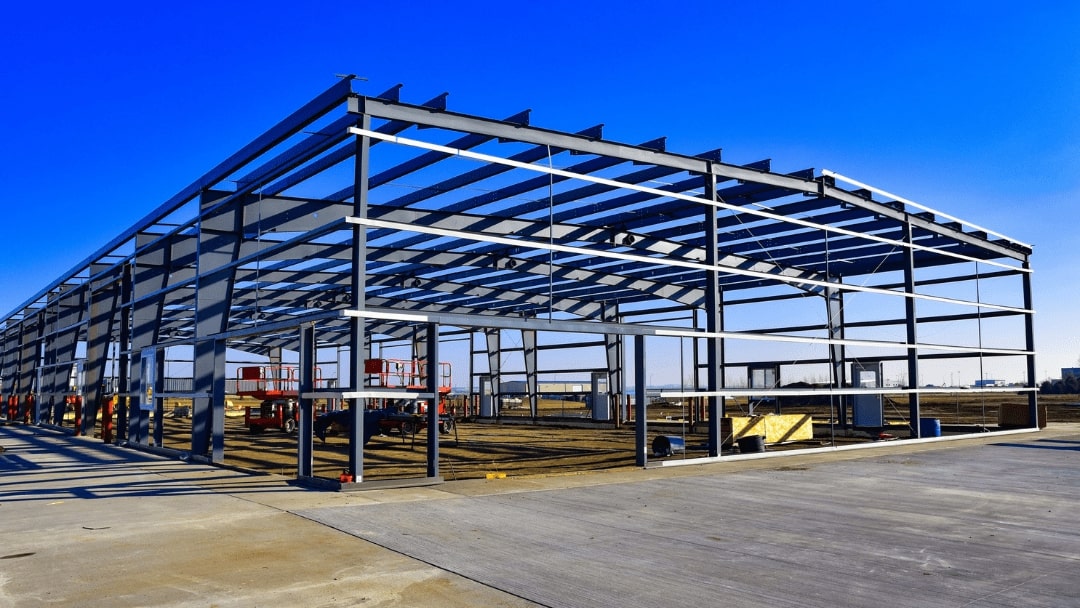
Small steel buildings cover footprints under 5,000 square feet — typically 30×40, 30×50, 40×60, or 40×80. These sizes are the most-searched on the consumer side, often for private garages, hobby workshops, small shops, and RV or boat storage.
Note: Titan’s minimum project size is approximately 5,000 sq ft (50×100). If you need a smaller building, a kit-style supplier focused on residential and hobby buildings is usually a better fit. The sizes below are listed for reference so you can match your need to a category.
| Size | Sq Ft | Typical Use | Best Eave Height |
|---|---|---|---|
| 30×40 | 1,200 | Two-car garage, small workshop, hobby shop | 12–14 ft |
| 30×50 | 1,500 | Three-car garage, RV storage | 14 ft |
| 40×60 | 2,400 | Workshop, small ag shop, equipment storage | 14–16 ft |
| 40×80 | 3,200 | Larger shop, small contractor yard, ag equipment | 16 ft |
| 50×60 | 3,000 | Auto shop, small commercial | 14–18 ft |
| 50×80 | 4,000 | Light commercial, workshop, retail | 16 ft |
Common small-building searches: “30×40 steel building cost,” “40×60 metal building,” “small steel shop building.” These keywords represent residential/hobby buyers and very small commercial operators — a different segment than Titan’s commercial and industrial customer base.
Medium-sized steel buildings cover footprints from 5,000 to roughly 15,000 square feet. This is where Titan does the bulk of its work: warehousing, light manufacturing, fabrication shops, agricultural equipment storage, aircraft hangars, riding arenas, and small distribution centres.
| Size | Sq Ft | Typical Use | Detail Page |
|---|---|---|---|
| 50×100 | 5,000 | Small warehouse, larger shop, light commercial — Titan’s entry size | 50×100 Cost Page |
| 60×80 | 4,800 | Mid-size shop, light commercial | Coming soon |
| 60×100 | 6,000 | Most-requested size — distribution warehouse, light manufacturing, ag equipment storage | 60×100 Cost Page |
| 60×120 | 7,200 | Mid-warehouse, distribution, mid-size manufacturing | 60×120 Cost Page |
| 80×100 | 8,000 | Wider warehouse, larger manufacturing, fabrication shop | 80×100 Cost Page |
| 80×120 | 9,600 | Large warehouse, regional distribution centre | 80×120 Cost Page |
| 80×150 | 12,000 | Distribution warehouse, cold storage, mid-large manufacturing | 80×150 Cost Page |
| 100×100 | 10,000 | Warehouse, aircraft hangar, large fab shop, ag complex | 100×100 Cost Page |
| 100×150 | 15,000 | Distribution centre, mid-large manufacturing, cold storage | 100×150 Cost Page |
The 60×100 is the most-requested size in Titan’s commercial and industrial inquiries — versatile enough for a distribution warehouse, light manufacturing facility, agricultural equipment shed, or fleet vehicle garage. See the full 60×100 Steel Building Cost in Canada page for province-by-province pricing and sample builds.
Large steel buildings cover footprints from 15,000 sq ft up to 100,000+ sq ft. These are primary distribution centres, manufacturing plants, sports complexes, regional warehouses, and large aircraft hangars. At this scale, frame design (clear span vs multi-span), crane provisions, dock-door counts, fire suppression, and snow/wind/seismic load calculations all become more involved.
| Size | Sq Ft | Typical Use | Frame Type |
|---|---|---|---|
| 80×200 | 16,000 | Dock-heavy distribution, cross-dock, long production line | Clear span |
| 100×200 | 20,000 | Riding arena, aircraft hangar, large warehouse, recreation | Clear span |
| 120×200 | 24,000 | Manufacturing plant, regional distribution | Clear or multi-span |
| 120×240 | 28,800 | Distribution centre, sports complex, large industrial | Clear or multi-span |
| 100×300 | 30,000 | Fulfilment centre, phased distribution, long production line | Clear span |
| 150×300 | 45,000 | Large warehouse, manufacturing plant, regional distribution | Multi-span typical |
| 200×400 | 80,000 | Primary distribution centre, large industrial facility | Multi-span |
| 200×500+ | 100,000+ | Large industrial, primary distribution, automotive plant | Multi-span / modular |
A quick 2026 budget benchmark by footprint. Figures are turnkey ranges in Canadian dollars — kit, foundation, erection, insulation, interior finishes, MEP rough-in, permits and inspections included. Turnkey pricing starts around $118 per sq ft and rises with eave height, snow/wind/seismic load, insulation, dock doors, crane provisions, and finish level. Larger footprints trend toward the lower end of the per-sq-ft range, and kit-only or shell packages cost significantly less. For an exact figure, use the Cost Calculator or the size-specific cost pages linked below.
| Size (W×L) | Floor Area | Turnkey $/sq ft | Typical 2026 Turnkey Range (CAD) | Best For |
|---|---|---|---|---|
| 50×100 | 5,000 sq ft | $118–$182 | $588K – $912K | Entry warehouse, larger shop, light commercial |
| 60×80 | 4,800 sq ft | $118–$182 | $564K – $876K | Mid-size shop, light commercial |
| 60×100 | 6,000 sq ft | $118–$182 | $706K – $1.09M | Most-requested — warehouse, manufacturing, ag |
| 60×120 | 7,200 sq ft | $118–$182 | $847K – $1.31M | Mid-warehouse, distribution |
| 80×100 | 8,000 sq ft | $118–$182 | $941K – $1.46M | Wider warehouse, larger manufacturing |
| 80×120 | 9,600 sq ft | $118–$182 | $1.13M – $1.75M | Regional distribution centre |
| 100×100 | 10,000 sq ft | $118–$182 | $1.18M – $1.82M | Warehouse, hangar, large fab shop |
| 80×150 | 12,000 sq ft | $118–$182 | $1.42M – $2.18M | Warehouse, cold storage, mid-large manufacturing |
| 100×150 | 15,000 sq ft | $118–$182 | $1.76M – $2.74M | Distribution centre, cold storage |
| 80×200 | 16,000 sq ft | $118–$182 | $1.89M – $2.91M | Dock-heavy distribution, long production line |
| 100×200 | 20,000 sq ft | $118–$182 | $2.35M – $3.65M | Riding arena, hangar, large warehouse |
| 120×200 | 24,000 sq ft | $118–$182 | $2.83M – $4.37M | Manufacturing plant, regional distribution |
| 120×240 | 28,800 sq ft | $118–$182 | $3.40M – $5.24M | Distribution centre, sports complex |
| 100×300 | 30,000 sq ft | $118–$182 | $3.54M – $5.46M | Fulfilment centre, phased distribution |
| 150×300 | 45,000 sq ft | $118–$182 | $5.29M – $8.21M | Large warehouse, manufacturing plant |
| 200×400 | 80,000 sq ft | $118–$182 | $9.41M – $14.59M | Primary distribution, large industrial |
The right size depends on what you’re building for. Below are the typical Canadian dimensions for each use case Titan delivers.
Canadian warehouse buildings typically run 60×100 (last-mile distribution), 80×120 (regional distribution), or 100×150 to 150×300 for primary distribution centres. Eave heights of 20–24 ft are standard to clear pallet-rack systems and dock-door equipment. See Steel Warehouse Buildings in Canada for spec options.
Most Canadian fabrication shops and tier-2 manufacturing facilities run 60×100 to 100×200, with eave heights of 20–24 ft for overhead cranes and process equipment. Crane-ready configurations require heavier columns and runway beams. See Steel Manufacturing Buildings.
Hangar sizing is driven by aircraft dimensions:
See Aircraft Hangar Steel Buildings for details on door systems and Transport Canada siting notes.
Equipment storage and ag shop buildings commonly run 60×100 to 80×160 on the prairies. Riding arenas have standardized sizing: 60×120 (small private), 80×200 (standard schooling), 100×220+ (competition). Dairy barns and livestock buildings vary widely by herd size. See Agricultural Steel Buildings, Dairy Barns, and Livestock Barns.
Sized to rack module and door spacing. Typical Canadian cold storage facilities run 80×120 to 150×300 with 28–36 ft eave heights for high racking. Insulated metal panels are the standard envelope. See Cold Storage Buildings.
Court, ice, and field-house buildings typically run 100×200 to 200×400+ with 30 ft+ eave for clear ceiling height. Single tennis or basketball courts fit in 60×120; full ice sheets need 100×220+ with high eave. See Sports Complex Steel Buildings.
Commercial steel buildings (car dealerships, auto-body shops, retail outlets, multi-tenant flex space) typically run 60×100 to 100×200 with 16–22 ft eaves. Façade treatments and fenestration drive most of the design conversation at this size class. See Commercial Steel Buildings.
For medium and large footprints, pre-engineered steel outperforms wood-frame (post-and-beam / pole barn) and fabric (tension-membrane) construction on clear span, lifespan, fire resistance, and long-run cost. Here is how the three compare at the sizes Titan supplies.
| Factor | Pre-Engineered Steel | Wood / Pole Barn | Fabric / Membrane |
|---|---|---|---|
| Practical clear-span width | Up to 300 ft | ~60–80 ft | Up to ~160 ft |
| Typical lifespan | 40–60+ years | 20–30 years | 15–25 years (cover shorter) |
| Fire resistance | Non-combustible | Combustible | Combustible / limited |
| Snow / wind capacity | Engineered to NBCC — highest | Moderate | Lower; limited in heavy-snow zones |
| Maintenance | Low | Moderate–high | Periodic cover replacement |
| Insurance & financing | Favourable (non-combustible) | Standard | Can be restricted |
| Best use | Warehouse, manufacturing, hangar, ag, commercial | Small ag, hobby, shelter | Temporary storage, sports bubbles, riding covers |
Picking the right footprint is the single most important decision in a steel building project. A building that’s slightly too small can cost you operational capacity for decades one that’s overbuilt wastes capital and adds heating, lighting, and tax expense. Work through these six criteria before you finalize the spec.
“Total sq ft” includes the entire footprint. “Usable” subtracts perimeter clearance, rack legs, dock pits, mezzanines, and equipment footprints. For warehouse use, plan for 60–75% of total sq ft as actually usable floor. For manufacturing, the ratio depends heavily on equipment layout.
The cheapest way to expand a steel building is to plan for it at the start. Build the foundation a bay longer than the initial structure, or design the endwall as a “removable” wall so a future addition bolts cleanly into the existing frame. Adding 20 ft of length later is dramatically cheaper if the original structure was engineered for it.
Pallet racking, mezzanines, overhead cranes, and process equipment all dictate minimum interior height. A common mistake is sizing the footprint correctly but specifying an eave that’s 2 ft too short — forcing expensive racking workarounds. Add interior clearance for sprinklers (typically 18 in. below the roof deck), lighting, and HVAC.
Count and size your doors before you finalize the building dimensions. Overhead doors, dock doors with levelers, drive-throughs, and bifold hangar doors all influence column placement and frame design. A 60×100 with one drive-through and three dock doors is engineered differently from a 60×100 with five man-doors and a small overhead.
Municipal setback requirements, lot coverage maximums, height limits, and fire-separation distances all constrain the building footprint before you start. Check your local zoning bylaw early — there’s no point sizing a 100×200 if your lot only accommodates 80×150. The Steel Building Permits in Canada (CSA A660) guide covers permit and code essentials.
Larger buildings have a lower price per square foot — fixed costs (engineering, delivery, foundation premiums, permits) get spread across more floor area. Expect 5–15% reduction in $/sq ft when comparing a 100×200 to a 60×100 with the same eave height and finish package. If you’re close to a size break point, scaling up can be cheaper per square foot than you’d expect. See the Commercial Steel Building Cost Guide Canada.
| Eave Height | What It’s For | Typical Sizes |
|---|---|---|
| 12–14 ft | Small storage, hobby workshop, residential garage | 30×40, 30×50, 40×60 |
| 16–18 ft | Standard warehousing, light manufacturing, ag equipment | 50×100, 60×100, 60×120, 80×120 |
| 20–24 ft | Crane-ready industrial, racking-intensive warehouses, larger ag equipment | 80×100, 100×150, 100×200 |
| 26–32 ft | Aircraft hangars, heavy industrial, high-bay distribution | 100×200, 120×240, 150×300 |
| 36 ft+ | Specialty: large hangars, certain industrial processes | Custom engineering required |
Width is the dimension that drives frame engineering and a substantial portion of the cost. Titan offers three frame configurations:
For technical material and finish options across all frame types, see Popular Materials for Modern Metal Buildings.
This is the master reference table of steel building dimensions commonly searched and built in Canada. Sizes Titan delivers are marked with a checkmark.
| Size | Sq Ft | Category | Common Use | Titan Builds |
|---|---|---|---|---|
| 30×40 | 1,200 | Small | 2-car garage, small shop | — |
| 30×50 | 1,500 | Small | 3-car garage, RV storage | — |
| 40×60 | 2,400 | Small | Workshop, hobby shop | — |
| 40×80 | 3,200 | Small | Larger shop, ag equipment | — |
| 50×80 | 4,000 | Small | Commercial shop | — |
| 50×100 | 5,000 | Medium | Entry warehouse, larger shop | ✓ |
| 60×80 | 4,800 | Medium | Mid-size shop | ✓ |
| 60×100 | 6,000 | Medium | Warehouse, manufacturing, ag | ✓ |
| 60×120 | 7,200 | Medium | Mid-warehouse, distribution | ✓ |
| 80×100 | 8,000 | Medium | Wider warehouse, fab shop | ✓ |
| 80×120 | 9,600 | Medium | Regional distribution | ✓ |
| 80×160 | 12,800 | Medium | Ag complex, ag warehouse | ✓ |
| 100×100 | 10,000 | Medium | Warehouse, hangar, fab | ✓ |
| 100×150 | 15,000 | Medium | Distribution centre, cold storage | ✓ |
| 100×200 | 20,000 | Large | Riding arena, hangar, large warehouse | ✓ |
| 120×200 | 24,000 | Large | Manufacturing, regional distribution | ✓ |
| 120×240 | 28,800 | Large | Distribution, sports complex | ✓ |
| 150×300 | 45,000 | Large | Large warehouse, plant | ✓ |
| 200×400 | 80,000 | Large | Primary distribution | ✓ |
| 200×500+ | 100,000+ | Large | Industrial, automotive plant | ✓ Custom |
Every Titan dimension is customizable in one-foot increments. There is no upcharge to specify non-standard width, length, or eave height — the building is engineered to your exact size and to the National Building Code requirements for your province. Common reasons clients specify a custom size:
Need something outside the standard catalogue? See Custom Steel Buildings Canada or use the Cost Calculator to enter your exact dimensions.
Enter your exact width, length, eave height, province, and use case into Titan’s Cost Calculator. You’ll receive a price range for kit, shell, and turnkey configurations in under two minutes.
The most-requested size in Titan’s commercial and industrial inquiries is 60×100 (6,000 sq ft) — used as a distribution warehouse, light manufacturing facility, or agricultural equipment shed. Other high-volume sizes are 80×120 (regional warehousing), 100×200 (riding arenas, hangars, and large warehouses), and 50×100 (entry-size warehouses).
Working definitions used across the Canadian PEMB industry:
Titan delivers clear-span pre-engineered steel buildings up to 300 ft wide with no interior columns. Above 300 ft, multi-span (modular) frames with interior columns are typically the more cost-effective option.
Titan’s minimum project size is approximately 5,000 sq ft — the smallest standard kit is 50×100. Smaller buildings are not in the standard catalogue; for projects under 5,000 sq ft, a kit-style supplier focused on hobby and residential buildings is usually a better fit.
Yes. Every Titan building is engineered to spec — width, length, eave height, and roof pitch are all custom. There is no upcharge to specify non-standard dimensions; the building is engineered to your exact size and to the National Building Code requirements for your province. See Custom Steel Buildings Canada.
Larger buildings have a lower price per square foot, all else equal — fixed costs (engineering, delivery, foundation premiums, permit overhead) get spread across more floor area. Expect roughly 5–15% reduction in $/sq ft when comparing a 100×200 to a 60×100 with the same eave height and finish package.
A 30×40 (1,200 sq ft) is small-building territory — typical for a two-car garage, hobby workshop, or small storage shed. A 60×100 (6,000 sq ft) is five times the floor area and shifts into the medium-commercial category — distribution warehousing, light manufacturing, or large agricultural equipment storage. The 60×100 also supports much taller eaves (up to 24 ft+ vs 14 ft) and clear-span design.
Yes — and the cheapest way to do it is to plan for expansion at the start. Design the foundation a bay longer than the initial structure, or treat one endwall as a “removable” wall so a future addition bolts cleanly into the existing rigid frame. Lateral additions (mono-slope lean-tos off a sidewall) are also straightforward. Retrofitting expansion onto a building that wasn’t engineered for it is doable but materially more expensive.
Standard pre-engineered steel buildings span 14 ft to 36 ft+ eave height. Most warehousing sits at 16–24 ft. Aircraft hangars, high-bay distribution, and certain industrial processes go to 30 ft+ with custom engineering. Above 40 ft eave, the design crosses into specialty industrial territory and the cost-per-sq-ft escalates significantly.
Typical Canadian lead times: 10–16 weeks from contract to kit delivery (driven by steel mill timing and engineering complexity). Erection of the shell is 3–6 weeks on a prepared foundation. Full turnkey including foundation, insulation, MEP rough-in, and finishes runs roughly 4–7 months end-to-end for a medium-sized building. Larger projects extend proportionally.
p>No. While certain sizes (60×100, 80×120, 100×200) are extremely common and have well-understood pricing, every Titan building is engineered to spec. The “standard sizes” you see across the industry are simply the most popular footprints — there’s no extra cost to specify, for example, 62×104 or 78×138 if those dimensions fit your site or operation better.
Titan delivers buildings to 100,000+ sq ft as custom quotes. Footprints of 200×500+ are typical primary distribution centres, large manufacturing plants, or automotive plants. At this scale, frame configuration moves to multi-span/modular, and design conversations involve crane provisions, fire suppression, occupancy classification, and seismic design (especially in BC). Contact us directly for projects of this scale.
Turnkey pre-engineered steel buildings in Canada run roughly $118 to $182 per square foot in 2026 — a complete building including foundation, erection, insulation, interior finishes, MEP rough-in, and permits. Kit-only packages cost far less (frames, panels, and sealed drawings only), and a building shell falls in between. Larger footprints trend toward the lower end because fixed costs spread across more floor area. See the Steel Building Cost by Size table for ranges by footprint.
For last-mile and 3PL distribution, a 60×100 (6,000 sq ft) with a 16–20 ft eave handles a few dock doors and standard pallet racking. Regional distribution typically steps up to 80×120 or 100×150 with 20–24 ft eaves to clear higher racking and multiple dock positions. Size the eave around your racking plus ~18 in. of sprinkler clearance below the roof deck.
Riding arenas follow standardized sizing: 60×120 for a small private arena, 80×200 for standard schooling, and 100×220+ for competition — all clear-span so there are no columns in the riding surface. See agricultural steel buildings.
These size and price guides apply to our industrial steel buildings and warehouse projects.