By Titan Steel Buildings Date: January 2026 Read Time: 6 Minutes
As Canadian industrial vacancy rates hover near historic lows in key hubs like Toronto and Vancouver, businesses are facing a “build or stagnate” ultimatum. With leasing options scarce and rents averaging nearly $15-$18 per square foot in major markets, the trend for 2026 is decisive: companies are building their own assets.
But the math of construction has changed.
For decades, the default for medium-sized industrial builds (10,000–20,000 sq. ft.) was often a debate between initial sticker price and speed. In 2026, however, a new factor has eclipsed material costs: Risk Management.
With commercial insurance premiums adjusting to new climate realities and financiers scrutinizing long-term asset viability, the “cheaper” wood-framed pole barn is increasingly becoming a liability. Here is why forward-thinking Canadian enterprises are pivoting to pre-engineered steel to secure their future.
1. The “Hidden” Inflation: The Insurance Premium Gap
While lumber prices have stabilized, the cost to insure a wood-framed commercial structure has not.
According to 2025/2026 market data, insurance carriers are applying stricter scrutiny to “combustible construction” (wood frame) versus “non-combustible” (steel). With wildfire risks rising from B.C. to Northern Ontario, and water damage claims surging, the premium gap is widening.
For a business owner, this creates a distinct operational disadvantage. A wood-framed warehouse often attracts significantly higher costs in two key areas:
- Builder’s Risk Insurance: During construction, wood sites are high-risk for fire and moisture damage. Industry data suggests steel framing can reduce Builder’s Risk premiums by up to 75% compared to wood.
- Property Premiums: Permanent premiums for wood structures can be 15–20% higher annually than for steel counterparts due to the “combustible” classification.
2026 Insurance Premium Comparison
Cost Per $100 of Insured Value
Wood Frame
$0.75 / $100
CombustibleTitan Steel Buildings
$0.25 / $100
Non-Combustible2. The 10,000 Sq. Ft. “Code Wall”
There is a specific threshold where wood framing ceases to be practical: 10,000 square feet.
Below this size, wood is a viable competitor. But once an industrial project crosses the 10,000 sq. ft. mark—the standard size for a functional logistics hub or manufacturing plant—building codes become exponentially more complex for wood structures.
Cumulative Cost of Ownership (10 Years)
The “Liability Cross”: Steel becomes cheaper than Wood at Month 38.
- Fire Separation: Large wood buildings often require expensive firewalls and aggressive sprinkler systems to meet code.
- The Column Problem: To support a roof spanning over 60–80 feet, wood typically requires internal support columns. In a logistics environment, every internal column is a dead zone that restricts forklift movement and racking layouts.
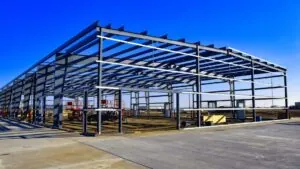
Pre-engineered steel bypasses this “code wall.” Titan Steel’s clear-span technology allows for structures up to 300 feet wide with zero internal columns. For a logistics company, this means 100% usable volume—a critical metric when calculating revenue per square foot.
3. The “Forever Asset” vs. The “Decaying Asset”
In the current high-interest environment, banks are prioritizing the longevity of the collateral they finance. This is where the “Asset Lifecycle” argument heavily favors steel.
- Wood’s Depreciation: Even treated lumber is organic. Over 20 years, it is subject to warping, rot, pest intrusion, and “structural creep” (sagging). A large wood warehouse built in 2026 will likely require significant structural maintenance by 2040.
- Steel’s Retained Equity: A steel structure is inorganic and dimensionally stable. It does not warp, rot, or feed termites.
Usable Industrial Lifespan
Before Major Structural Rehabilitation is Required
4. The 2026 Forecast: Industrialized Construction
The Canadian construction sector is currently battling a severe labor shortage, with over 100,000 unfilled positions expected in 2026. This is accelerating the shift toward “Industrialized Construction“—building off-site to save time on-site.
Traditional wood framing requires weeks of on-site labor from skilled carpenters who are in short supply. In contrast, Titan Steel’s pre-engineered kits are manufactured to exact specifications in the factory and shipped to the site ready for assembly. This slashes construction time by 30–50%, allowing businesses to move in and start generating revenue months sooner than traditional builds.
Key Takeaways for Canadian Business Owners
- Insurance Savings: Steel buildings are classified as “Non-Combustible,” lowering both construction and long-term property insurance rates.
- Maximize Space: For buildings over 10,000 sq. ft., steel offers clear-span designs that eliminate columns, maximizing warehouse efficiency.
- Speed to Market: Pre-engineered kits mitigate the 2026 labor shortage, allowing for faster occupancy.
FAQ: Steel vs. Wood for Industrial Building
Is it cheaper to build a Steel warehouse than with wood in 2026?
While wood may have a lower initial material cost (5-10% less), steel is generally cheaper over a 5-year period when factoring in lower insurance premiums, reduced maintenance, and faster construction times.
Do steel buildings have lower insurance rates in Canada?
Yes. Steel is classified as a “non-combustible” material. Data suggests this can lower Builder’s Risk insurance by up to 75% and general property liability premiums by 15-20% compared to wood-framed structures.
What is the maximum width of a clear-span steel building?
Pre-engineered steel buildings can span up to 300 feet (approx. 91 meters) without any internal columns, whereas wood trusses typically require support columns for spans over 80 feet.