Choosing the right metal building supplier in Ontario is one of the most consequential decisions in any steel construction project. The supplier you select determines engineering quality, code compliance, lead times, and the long-term performance of your structure under Ontario’s demanding climate conditions. This guide explains how Ontario’s supplier landscape works, what separates strong partners from weak ones, and how to evaluate your options before committing to a contract.
- Ontario buyers must distinguish between manufacturers, distributors, brokers, and design-build contractors before requesting quotes.
- Pre-engineered metal buildings (PEMBs) must comply with the Ontario Building Code and CSA standards; your supplier’s engineering documentation directly affects permit approval.
- Lead times, delivery logistics, and erection support vary significantly across supplier types and should be confirmed in writing.
- Snow loads, wind uplift, and seismic requirements differ across Ontario regions and must be engineered into the building package, not added later.
- The lowest quoted price rarely reflects the lowest total project cost; understanding what is and is not included in a quote is essential.
Definitions & scope
A metal building supplier is any company that provides a steel or metal building system to an end buyer. In Ontario, this term covers a wide range of business models. A manufacturer designs and fabricates the primary structural steel, secondary framing, and cladding panels at its own facility. A distributor resells packages produced by a manufacturer, sometimes adding local engineering support. A broker acts as an intermediary, sourcing packages from multiple manufacturers without controlling fabrication. A design-build contractor combines supply with site preparation, foundation work, and erection under a single contract.
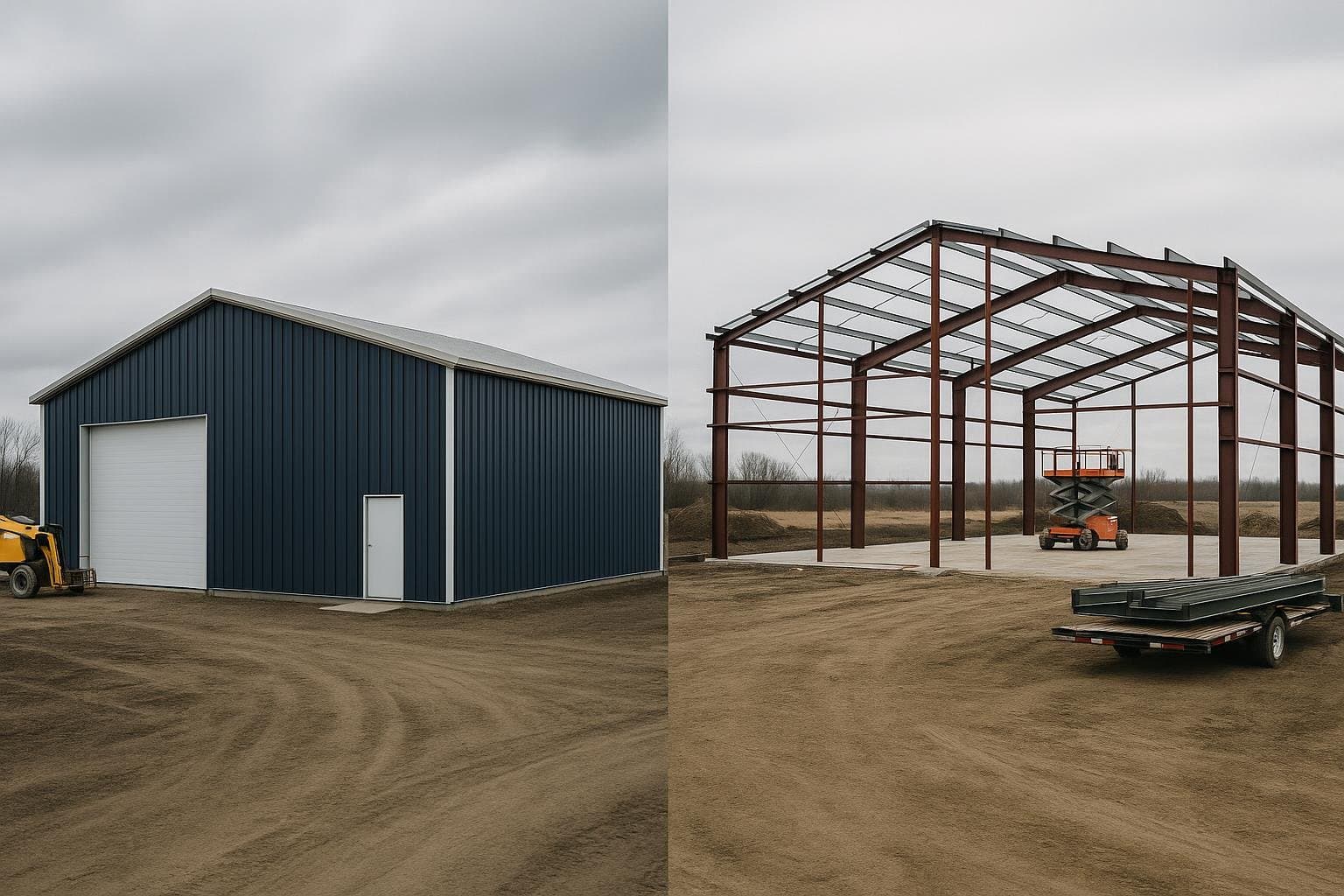
The term “pre-engineered metal building” (PEMB) refers specifically to a system where the structural frame is engineered and fabricated off-site to a defined load specification, then shipped as a kit for assembly. This differs from conventional structural steel, where fabrication is custom and site-specific. Both categories are available from Ontario-serving suppliers, though PEMBs dominate the agricultural, commercial, and light-industrial segments because of their faster lead times and lower per-square-foot cost at typical spans.
This guide focuses on the supplier selection process for buyers in Ontario seeking buildings for agricultural, commercial, industrial, or aviation use.
Why this matters
Ontario’s construction environment places specific demands on metal building suppliers that buyers in other jurisdictions may not encounter. The Ontario Building Code (OBC) requires that structural drawings be prepared or reviewed by a licensed professional engineer registered in Ontario. A supplier whose engineering team is not licensed in Ontario cannot produce permit-ready drawings without engaging a local engineer, which adds cost and time.
Ontario’s climate also imposes real structural requirements. Ground snow loads range from roughly 1.0 kPa in southwestern Ontario to over 3.0 kPa in parts of Northern Ontario, according to the National Building Code of Canada climatic data. Wind and seismic zones vary by municipality. A supplier that applies a generic national load table without verifying local climatic data for your specific site is creating a compliance risk.
Beyond code, the sheer scale of Ontario’s geography matters. A supplier based in Alberta or the United States may quote competitive steel prices but face freight costs, border delays, or delivery logistics that erode that advantage. Conversely, a supplier with Ontario-based engineering relationships and established carrier routes can often provide more predictable timelines.
Finally, Ontario’s agricultural and industrial sectors have distinct building needs. Dairy barns, equipment storage, aircraft hangars, and warehouses each carry different span, clearance, ventilation, and door requirements. A supplier experienced in the relevant building type will anticipate those requirements; one that is not may miss them until the project is underway.
For a broader view of the Canadian supplier landscape, see the Steel Building Supplier in Canada overview.
Your options
Direct manufacturer partner
A direct manufacturer partner designs, engineers, and fabricates the building system in-house, then supplies it directly to the buyer or through a tight network of regional partners. The buyer deals with a single point of accountability for engineering, fabrication quality, and delivery. This model typically offers the clearest chain of responsibility when issues arise. It works best for buyers with defined project requirements who want engineering documentation produced by the same team that fabricated the steel. The main limitation is that manufacturers may have minimum order sizes or lead times that do not suit very small or very fast-turnaround projects.
Distributor or authorized dealer
Distributors purchase building packages from one or more manufacturers and resell them with added local services such as permit coordination, site visits, or erection referrals. They often provide faster local response than a manufacturer’s direct sales team and may carry relationships with Ontario-licensed engineers. This model suits buyers who want a local point of contact but do not need to manage the manufacturer relationship directly. The limitation is that the distributor’s markup adds cost, and the buyer has less visibility into fabrication quality controls.
Steel building broker
Brokers source packages from multiple manufacturers, sometimes internationally, and present the lowest-cost option to the buyer. They can be useful for price comparison but carry higher risk: the buyer may not know which manufacturer produced the package, what quality controls were applied, or whether the engineering is stamped by an Ontario-licensed engineer. Brokers are best suited to experienced buyers who can independently verify engineering credentials and fabrication standards. They are a poor fit for first-time buyers or complex projects.
Design-build contractor
A design-build contractor combines the supply of the metal building package with site preparation, foundation construction, and erection under a single contract. This model reduces coordination burden for the buyer and provides a single point of accountability for the complete project. It works well for buyers who lack construction management experience or who want a fixed-price contract covering all phases. The limitation is that design-build contracts can be harder to compare across suppliers because scope definitions vary, and the buyer has less control over subcontractor selection.
Kit supplier (owner-erect)
Some suppliers sell pre-engineered building kits intended for owner-erection or erection by a local contractor hired separately by the buyer. The kit includes primary and secondary framing, cladding, fasteners, and erection drawings. This model offers the lowest supply cost but places full responsibility for erection quality, permit coordination, and site management on the buyer. It is best suited to buyers with construction experience, a reliable local erection crew, and straightforward building types such as agricultural storage. It is not appropriate for complex commercial or industrial projects where engineering coordination is ongoing.
Conventional structural steel fabricator
For large-span industrial buildings, multi-storey structures, or projects with highly custom geometry, a conventional structural steel fabricator may be the appropriate supplier. Unlike PEMB manufacturers, conventional fabricators work from architect- or engineer-supplied drawings and produce custom members. Lead times are longer and costs per square foot are typically higher, but the design flexibility is greater. This option is most relevant for manufacturing plants, large warehouses, and specialized facilities where a standard PEMB frame cannot meet the functional requirements.
Options compared
| Supplier type | Best for | Typical considerations | Key limitations |
|---|---|---|---|
| Direct manufacturer partner | Mid-to-large commercial, industrial, agricultural projects | Single accountability, in-house engineering, clear fabrication standards | May have minimum project size; longer initial sales process |
| Distributor / authorized dealer | Buyers wanting local support and permit coordination | Local relationships, faster response, Ontario engineer access | Markup over manufacturer cost; less fabrication visibility |
| Steel building broker | Experienced buyers focused on price comparison | Potentially lower supply cost; multiple manufacturer options | Variable engineering quality; Ontario stamp not guaranteed |
| Design-build contractor | Buyers wanting a single contract for full project delivery | Reduced coordination burden; fixed-price potential | Harder to compare quotes; less subcontractor control |
| Kit supplier (owner-erect) | Agricultural storage; experienced owner-builders | Lowest supply cost; buyer controls erection crew | Full site and permit responsibility on buyer; not suited to complex builds |
| Conventional structural fabricator | Large-span, custom, or multi-storey industrial projects | Maximum design flexibility; custom member fabrication | Higher cost per sq ft; longer lead times than PEMB |
The table above illustrates that no single supplier type is universally superior. A buyer planning a 10,000 sq ft agricultural equipment storage building has different priorities than one planning a 50,000 sq ft distribution warehouse. The most important step is matching the supplier model to the project’s complexity, timeline, and the buyer’s capacity to manage construction coordination. Buyers with limited construction experience generally benefit most from a direct manufacturer partner or design-build contractor, where accountability is concentrated and documentation is produced by the party responsible for the outcome.
How to choose
Use the following decision framework to narrow your supplier type before requesting quotes.
Choose a direct manufacturer partner if your project is mid-to-large scale, you want engineering produced by the fabricating team, and you are prepared to manage erection separately or through a referred contractor. This model suits commercial buildings, warehouses, and agricultural facilities where engineering documentation quality is a priority for permit approval.
Choose a distributor or authorized dealer if you want a local Ontario contact who can coordinate permit submissions, attend site meetings, and refer vetted erection crews. This works well for buyers who are not familiar with the permit process and want guided support without the complexity of a full design-build contract.
Choose a design-build contractor if you want a single fixed-price contract covering supply, foundation, and erection, and you are willing to pay a premium for that coordination. This is the lowest-risk model for buyers with no prior steel building experience.
Choose a kit supplier if you have an experienced erection crew, a straightforward agricultural or storage building type, and you want to minimize supply cost. Confirm that the kit includes Ontario-stamped engineering drawings before purchasing.
Choose a conventional structural fabricator if your project requires spans, clearances, or geometries that a standard PEMB catalogue cannot accommodate, or if your architect has produced custom structural drawings that require fabrication to specification.
Avoid brokers unless you have the technical capacity to independently verify engineering credentials, fabrication standards, and delivery terms. The price advantage a broker may offer can disappear quickly if engineering revisions or delivery delays arise.
For guidance on pre-engineered options specifically, see the Pre-Engineered Steel Buildings in Ontario guide and the Prefab Steel Buildings Ontario guide.
Costs & timelines
No verified current price data has been supplied to this page. The following describes cost drivers only, ranked by typical impact on total project cost. Buyers should request itemized quotes from suppliers and consult the Metal Building Prices and Cost in Canada guide for a detailed breakdown of what drives quotes.
| Cost driver | Relative impact | Ontario-specific notes |
|---|---|---|
| Building size and clear span | Highest | Wider spans require heavier primary frame steel; tonnage drives fabrication cost disproportionately |
| Ontario-specific load requirements | High | Northern Ontario ground snow loads can exceed 3.0 kPa; seismic and wind zones vary by municipality |
| Cladding and insulation specification | High | Standing-seam roofing and insulated panels add significant cost over basic ribbed steel cladding |
| Doors, windows, and openings | Moderate | Large overhead or bi-fold hangar doors require structural framing; quantity and type should be confirmed before engineering begins |
| Foundation type and site conditions | Moderate | Frost depth ranges from approximately 1.2 m in southern Ontario to over 1.8 m in the north; poor bearing soils require engineered solutions |
| Erection labour | Moderate | Northern Ontario locations typically carry higher erection costs due to travel and accommodation |
| Steel market conditions and lead time | Variable | Steel commodity prices fluctuate; buyers who allow standard lead times generally receive more competitive pricing than those requiring expedited fabrication |
The table above ranks cost drivers by typical relative impact. Exact pricing depends on current steel market conditions, supplier capacity, and project-specific scope. See the Steel Building Insulation guide for cladding and insulation detail, and the Steel Building Foundation Requirements guide for foundation cost factors.
Risks & common mistakes
Accepting a quote that excludes engineering. Some suppliers quote the steel package only, excluding the Ontario-licensed engineering drawings required for a building permit. The buyer discovers the gap only when the municipality requests stamped drawings. Always confirm whether engineering is included and whether the engineer is licensed in Ontario.
Underspecifying loads. Buyers sometimes accept a supplier’s default load table without verifying it against their specific municipality’s climatic data. The National Building Code of Canada provides climatic data by location; your supplier should reference your site’s specific values, not a regional average. Underspecified buildings may fail permit review or perform inadequately under actual weather conditions.
Comparing quotes with different scopes. A quote that includes delivery, erection drawings, and anchor bolt templates is not directly comparable to one that includes steel supply only. Build a scope checklist and confirm each item across all quotes before making a decision.
Ignoring lead times in project scheduling. PEMB fabrication lead times typically range from several weeks to several months depending on manufacturer capacity and project complexity. Buyers who sign a lease or set a construction start date before confirming a supplier’s lead time risk costly delays.
Skipping the permit process. Ontario municipalities require building permits for virtually all permanent structures. Erecting a metal building without a permit creates legal liability, insurance voidance risk, and potential demolition orders. Confirm permit requirements with your local building department before construction begins. The CSA-A660 Compliance and Permits guide provides a useful overview.
Choosing a supplier without Ontario engineering credentials. A supplier whose engineers are not licensed in Ontario cannot produce the stamped drawings required by the OBC. Verify professional engineer registration before signing a contract.
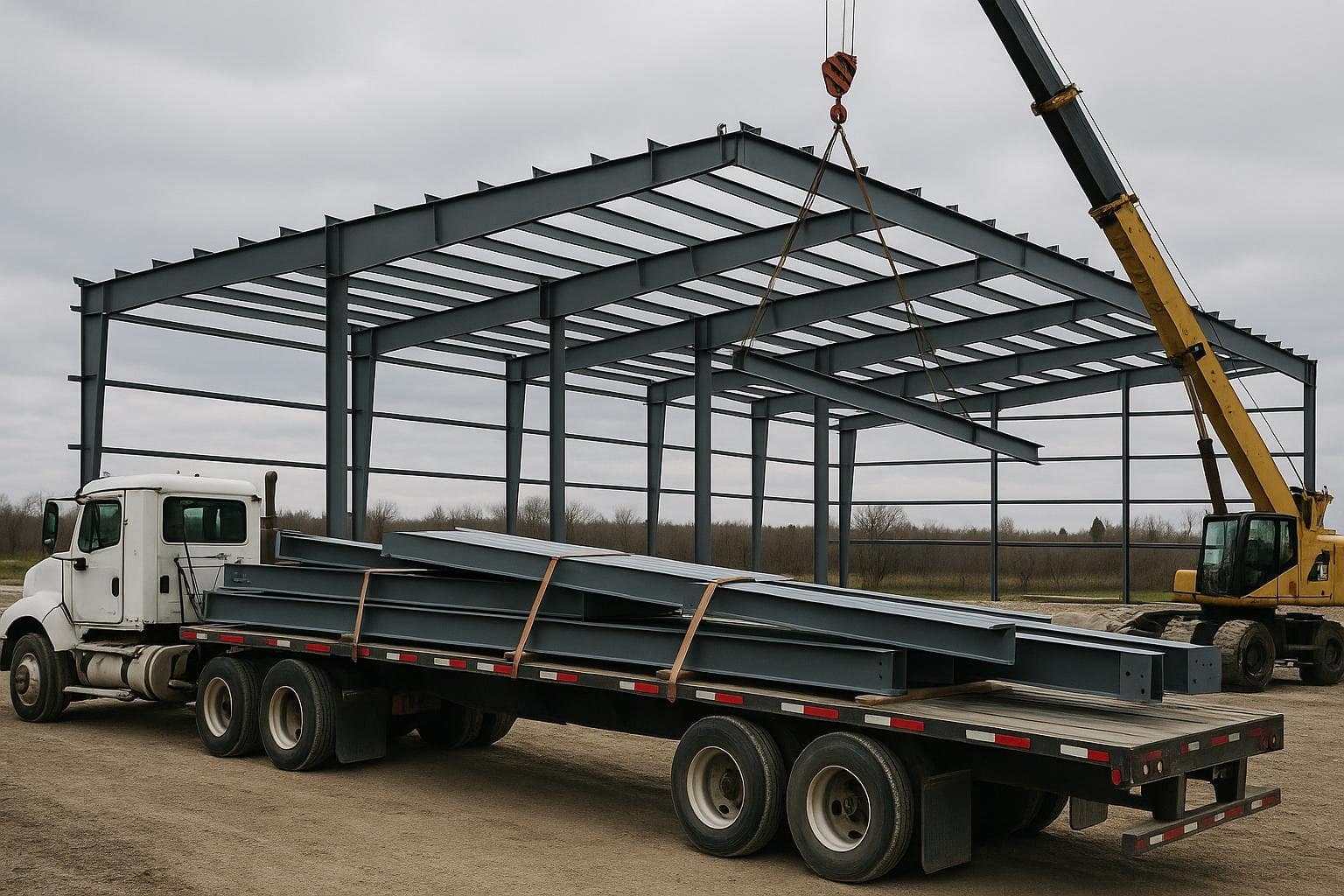
Neglecting site access for delivery. Large steel packages arrive by flatbed truck. Sites with restricted access, soft ground, or low overhead clearances can create significant delivery complications. Confirm delivery requirements with your supplier before finalizing the site plan.
How the process works
- Define your project requirements. Establish the building’s intended use, required dimensions, clear height, door locations, load requirements, and site address. The more specific your brief, the more accurate and comparable your quotes will be.
- Request quotes from shortlisted suppliers. Contact two to four suppliers with your project brief. Ask each to confirm whether engineering is included, whether the engineer is Ontario-licensed, what the lead time is from order to delivery, and what is excluded from the quoted price.
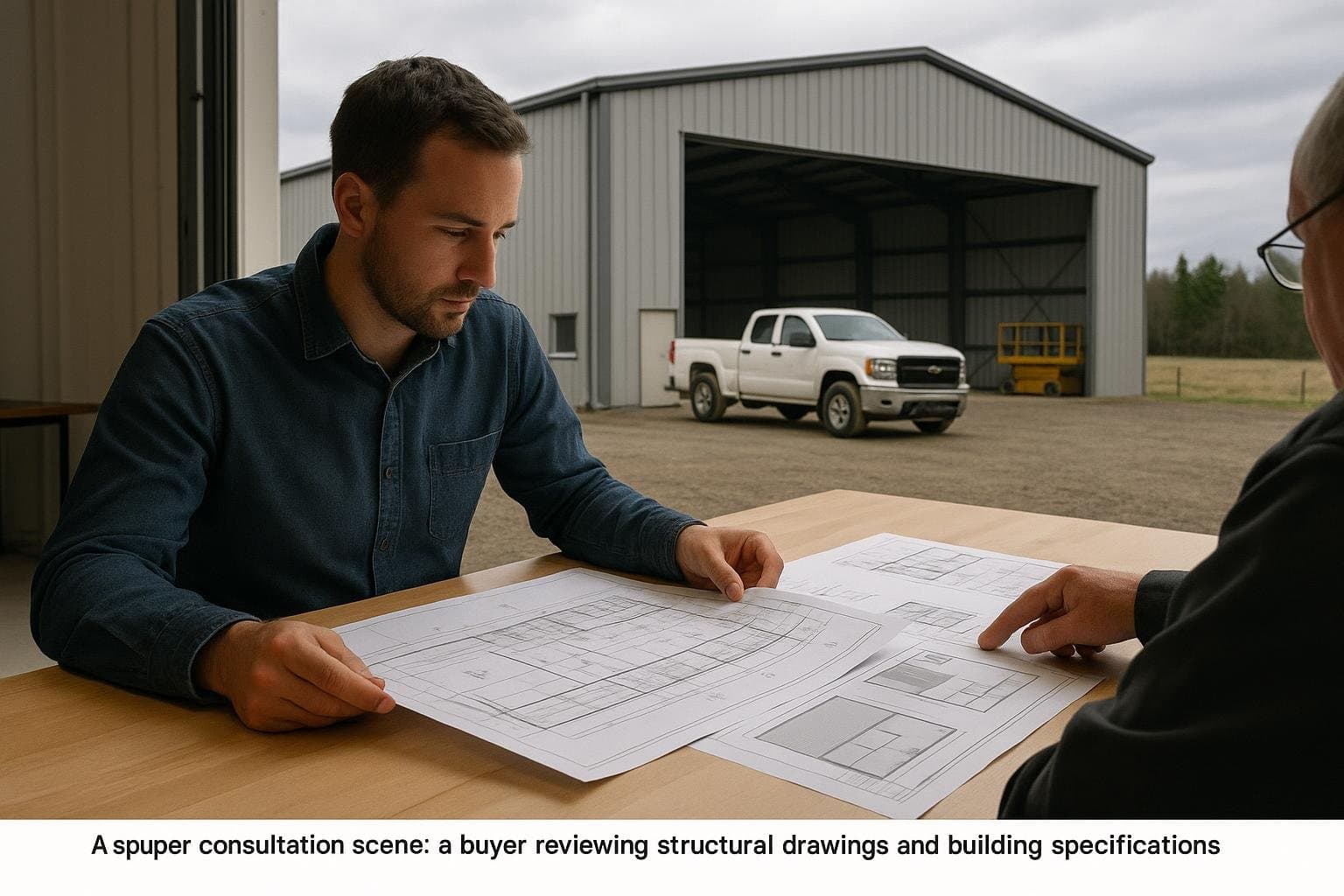
- Review engineering and permit documentation. Once you select a supplier, the engineering phase begins. The supplier or their engineer produces stamped structural drawings, which you submit to your local building department along with a permit application. Allow time for municipal review, which varies by municipality.
- Confirm foundation design and site preparation. Your foundation contractor works from the supplier’s anchor bolt plan and foundation loads. Foundation construction typically occurs while the building package is being fabricated, allowing parallel scheduling.
- Receive and inspect the building package. The steel package is delivered by flatbed. Inspect the delivery against the packing list before signing the bill of lading. Report any damaged or missing components to the supplier immediately.
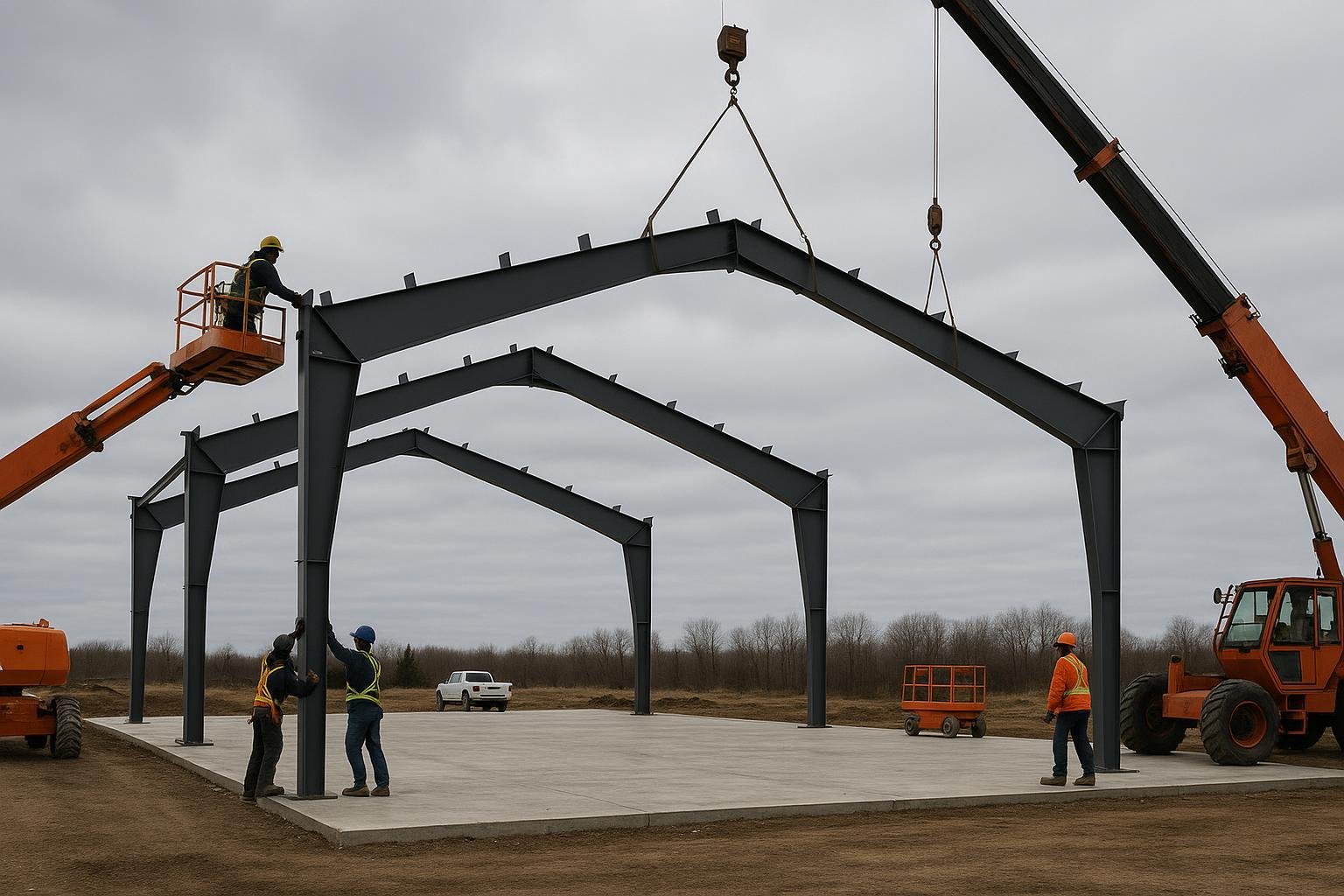
- Erect the building. An experienced erection crew assembles the primary frame, secondary framing, and cladding following the supplier’s erection drawings. The sequence matters; follow the drawings rather than improvising.
- Obtain occupancy approval. After erection, your building department may require a final inspection before the structure can be occupied. Confirm inspection requirements with your municipality at the permit application stage.
Frequently asked questions
What makes a metal building supplier qualified to serve Ontario buyers?
A qualified supplier serving Ontario should be able to provide structural engineering drawings stamped by a professional engineer licensed in Ontario, reference your site’s specific climatic data from the National Building Code of Canada, and deliver a package that meets the Ontario Building Code. They should also be able to confirm their fabrication quality controls and provide clear documentation of what is and is not included in their quoted price. Licensing and engineering credentials are the non-negotiable starting point.
Do I need a building permit for a metal building in Ontario?
Yes, in virtually all cases. Ontario municipalities require building permits for permanent structures, including pre-engineered metal buildings used for agricultural, commercial, or industrial purposes. Some agricultural exemptions exist under the Building Code Act for certain farm buildings on farm properties, but these exemptions have specific conditions and do not eliminate the need for structurally sound engineering. Confirm requirements with your local building department before beginning any work. The Steel Building Permits guide provides further context.
How long does it take to receive a metal building package in Ontario?
Lead times vary by supplier, building complexity, and current manufacturing capacity. Pre-engineered building packages typically require several weeks to several months from order confirmation to delivery. Engineering and permit review add time before fabrication can begin. Buyers should confirm lead times in writing at the quote stage and build those timelines into their project schedule. Expedited fabrication is sometimes available at a premium.
What snow load should my Ontario metal building be designed for?
Ground snow loads in Ontario vary significantly by location. The National Building Code of Canada provides climatic data tables by municipality. Southwestern Ontario locations generally carry lower ground snow loads than Northern Ontario communities, where loads can exceed 3.0 kPa. Your supplier’s engineer must reference the specific climatic data for your site address, not a regional average. See the Steel Building Snow Load in Canada guide for a detailed explanation of how snow loads are calculated and applied.
Can I erect a metal building kit myself in Ontario?
Owner-erection is possible for some building types, particularly smaller agricultural structures, provided you have the necessary skills, equipment, and a valid building permit. The erection drawings supplied with the kit must be followed precisely. For commercial or industrial buildings, most municipalities will require that erection be supervised or performed by qualified trades. Regardless of who erects the building, the structure must pass any required inspections before occupancy. Confirm erection requirements with your local building department before purchasing a kit.
What is the difference between a PEMB supplier and a conventional steel fabricator?
A pre-engineered metal building (PEMB) supplier produces a standardized structural system engineered to defined load parameters and fabricated off-site as a kit. A conventional steel fabricator produces custom members from architect- or engineer-supplied drawings, with no standardized system. PEMBs are faster to deliver and typically lower in cost per square foot for standard spans and uses. Conventional fabrication offers greater design flexibility for complex or large-span structures. See the PEMB vs. Conventional Steel guide for a detailed comparison.
What should I look for in a supplier’s quote to avoid hidden costs?
Ask each supplier to confirm whether the following are included: Ontario-stamped engineering drawings, delivery to your site, anchor bolt templates, erection drawings, and any required secondary framing or trim. Confirm what is excluded, such as foundation design, erection labour, insulation, doors, and electrical rough-ins. A quote that appears lower may exclude items that a higher quote includes. Build a consistent scope checklist and apply it to every quote you receive before making a comparison.
Does the supplier need to be located in Ontario?
No, but the engineering must be stamped by a professional engineer licensed in Ontario regardless of where the supplier is based. Out-of-province or international suppliers can serve Ontario buyers, but they must either employ Ontario-licensed engineers or engage a local engineer to review and stamp the drawings. Freight costs and delivery logistics from distant suppliers should be factored into the total cost comparison. Suppliers with established Ontario delivery routes and engineering relationships often provide more predictable timelines.
What building types can a metal building supplier in Ontario provide?
Ontario-serving metal building suppliers can provide structures for a wide range of uses, including agricultural storage and livestock facilities, commercial garages and workshops, warehouses and distribution centres, manufacturing and industrial buildings, aircraft hangars, and recreational or arena buildings. The supplier’s experience with your specific building type matters because each use carries distinct span, clearance, ventilation, and door requirements. Confirm that the supplier has relevant experience before committing. Titan’s product range includes agricultural buildings, commercial steel buildings, steel warehouses, and aircraft hangars.
How do I compare metal building suppliers in Ontario fairly?
Start by confirming that all suppliers are quoting the same scope, the same building dimensions, and the same load specification for your site. Verify that each quote includes Ontario-stamped engineering. Ask for references from completed projects of similar type and scale. Confirm lead times, delivery terms, and what happens if components are damaged in transit. Price is one factor among several; engineering quality, documentation completeness, and supplier responsiveness are equally important to a successful project outcome. The 2026 Buyer’s Guide to Evaluating Metal and Steel Building Suppliers provides a structured evaluation framework.
If you are ready to discuss your Ontario project, contact the Titan Steel Buildings team for a project consultation. Titan serves buyers across Ontario and across Canada as a pre-engineered and structural steel building supplier. You can also explore the full range of metal buildings available or visit the Steel Buildings Ontario page for region-specific information.